60/40 RECKONING
How Catastrophe Bonds Are Helping Redefine Portfolio Resilience
The 60/40 portfolio, long regarded as the cornerstone of institutional and retail asset allocation, has come under increased scrutiny in recent years. Instances of simultaneous equity and bond drawdowns, driven by inflation shocks and fiscal uncertainty, have raised questions about its future viability.
The 60/40 portfolio, long regarded as the cornerstone of institutional and retail asset allocation, has come under increased scrutiny in recent years. Instances of simultaneous equity and bond drawdowns, driven by inflation shocks and fiscal uncertainty, have raised questions about its future viability. This paper explores the limitations of traditional diversification strategies and examines how catastrophe bonds (CAT bonds), a segment of the insurance-linked securities (ILS) market, offer a rare source of truly uncorrelated return. We analyze the global correlation trap, evaluate the performance of alternative fixed income strategies under stress, and highlight the historical stability of the CAT bond market through the lens of the Swiss Re Global CAT Bond Index.
1. THE CRACKS IN 60/40
Fordecades, the 60/40 portfoliocomprising 60% equities and 40% government bonds provided consistent risk-adjusted returns and dependable diversification. The underlying assumptions were clear that when equity markets declined, bond prices would rise, offering a cushion during periods of heightened volatility. However, this inverse relationship has begun to show signs of breaking down.
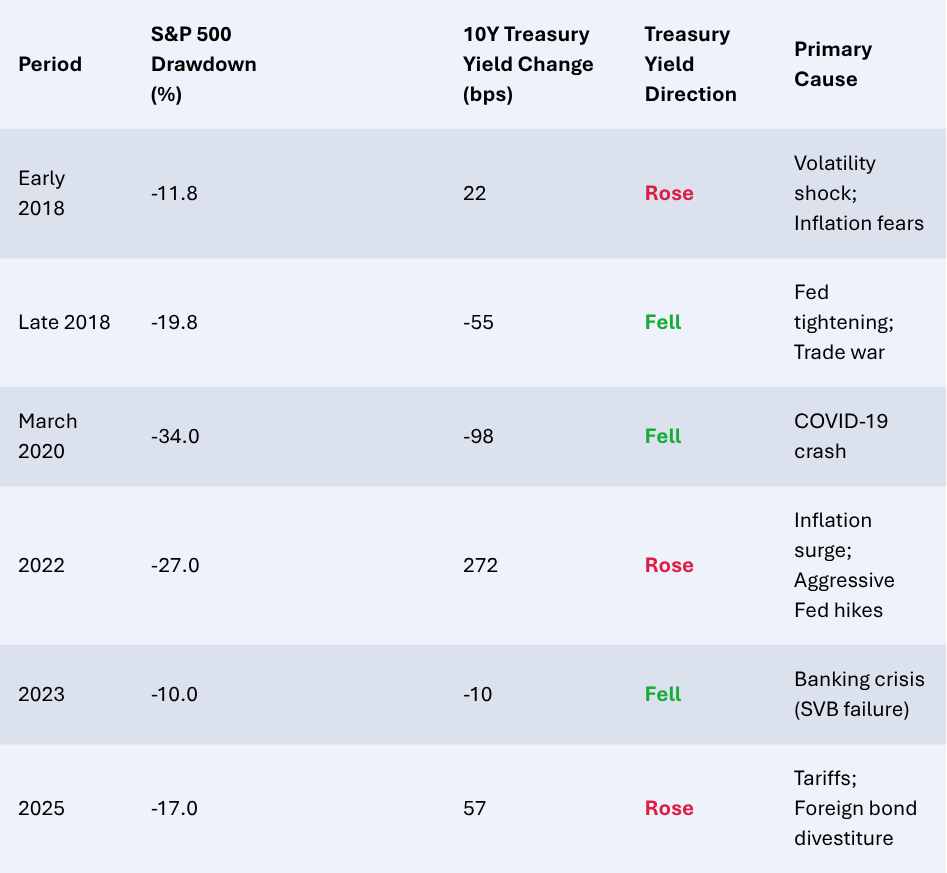
The 2022 market correction exposed a key vulnerability. Inflation spiked to multi-decade highs, prompting the Federal Reserve to raise interest rates aggressively. The result? Equities declined, but instead of serving as a hedge, U.S. Treasuries also fell sharply. This instance of dual drawdowns was particularly damaging to balanced portfolios and has recently begun to happen with greater frequency.
A closer look at market history reveals other such moments. The table below highlights several periods where equity markets sold off and Treasury yields rose a dynamic that severely challenges the premise of the 60/40 strategy. Recently, following the introduction of tariffs on April 2nd, 2025, the yield on the 10-year Treasury Note rose from 4.01% to 4.58% in a single week (57 bpts.). The 10-year Treasury Note dropped 2.8% in the subsequent 10 days as the S&P simultaneously declined. These lockstep declines should lead market participants to question the validity of the 60/40 model in today’s macroeconomic environment.
Since 2018, when the S&P has experienced declines of 10% or greater in over 50% of those instances, Treasury bond yields have risen.
TABLE 1: MARKET CORRECTIONS AND TREASURY YIELD SPIKES
2. THE GLOBAL CORRELATION TRAP AND ALTERNATIVES UNDER PRESSURE
To mitigate interest rate risk and boost yield, many asset allocators have diversified into alternative fixed-income strategies. These include high-yield bonds, private credit, real estate debt, and infrastructure finance. While these asset classes offer attractive returns in benign environments, their diversification benefits may be overstated. The GFC (2007-2009) and the COVID-19 market collapse in early 2020 provided a critical stress test. Both high-yield corporate bonds and leveraged loans experienced rapid declines in concert with equities. Private credit though less marked-to-market showed similar credit spread behavior. This underscores a key point: alternative fixed income instruments remain fundamentally exposed to the same systemic credit risks as traditional bonds.
TABLE 2: MARKET CORRECTIONS AND TREASURY YIELD SPIKES
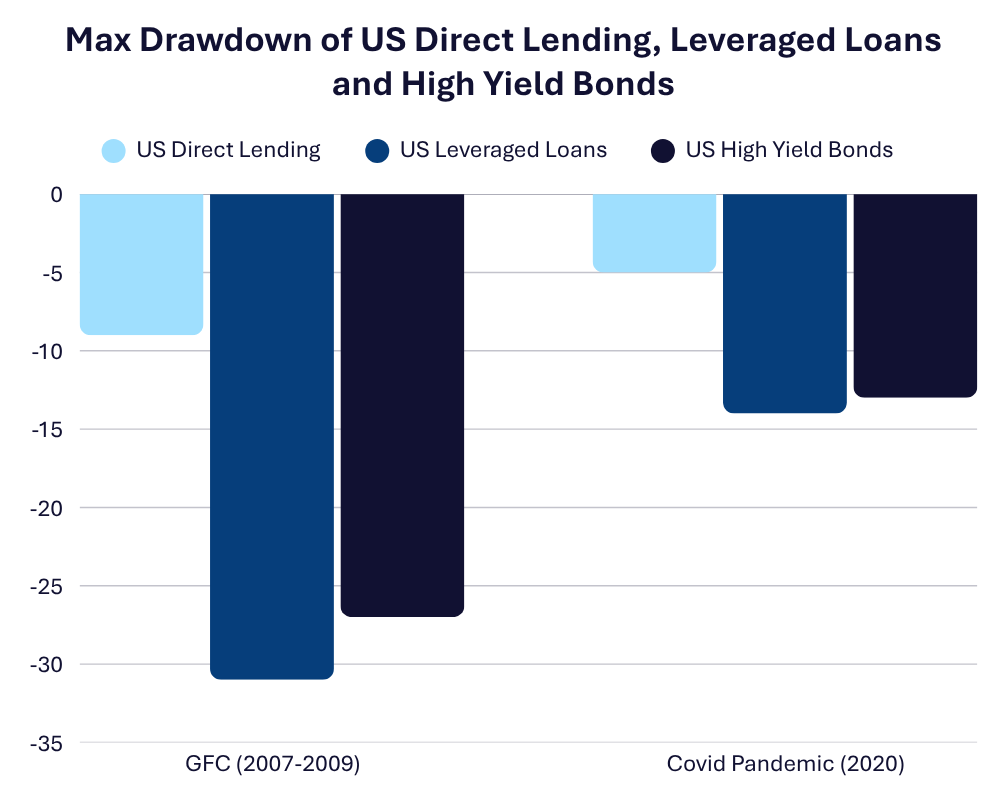
“US Direct Lending” = Cliffwater Direct Lending Index
“US Leveraged Loans” = iBoxx USD Leveraged Loan Index
“US High Yield Bonds” = Bloomberg US Corporate High Yield Total Return Index Value Unhedged USD Source: Bloomberg, Cliffwater
Additionally, most alternative credit strategies share two common traits:
- Pro-cyclicality: Their performance is often strongest during economic expansions and weakest during recessions.
- Liquidity mismatch: Many vehicles promise stable returns while holding underlying assets with limited liquidity, increasing redemption risk during stress events.
Thus, while these strategies add return potential, they do not necessarily add true diversification, especially when markets are under pressure.
3. CATASTROPHE BONDS: DIVERSIFICATION THROUGH UNCORRELATED RISK
Catastrophe bonds operate on a different axis. Issued by insurers and reinsurers, CAT bonds transfer specific event-driven risks—such as earthquakes or hurricanes to capital markets. If no qualifying event occurs during the term of the bond, investors receive an attractive yield and return of principal. If a covered event does occur, a portion or all the principal may be used to cover insurance losses.
Because CAT bonds are driven by natural peril risk, not macroeconomic risk, they can demonstrate:
- Minimal correlation with equities, Treasuries, or credit
- Attractive yields typically ranging from 5–10%
- Short duration and floating rate structure, reducing interest rate sensitivity
- Losses that are tied to event occurrence—not spread widening or systemic financial stress
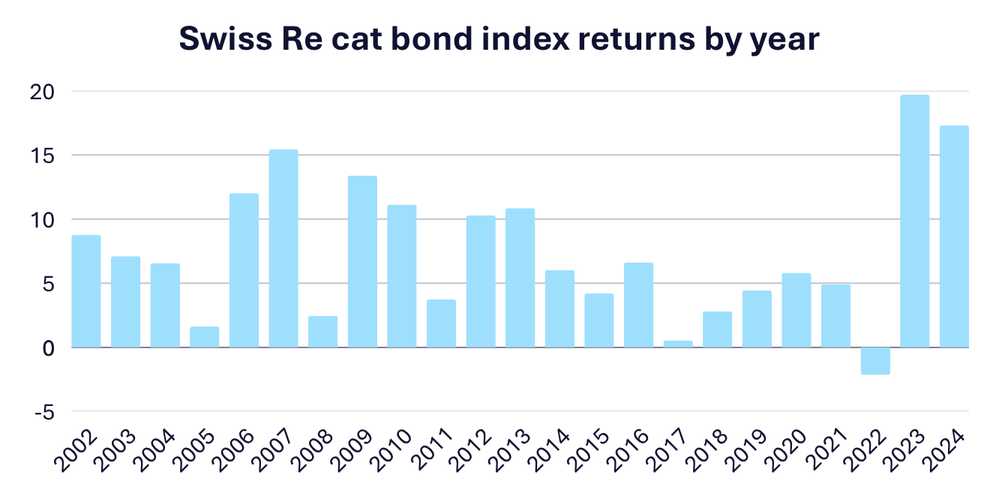
Swiss Re’s Global Cat Bond Index has served as a useful benchmark. With only two negative return years since its inception in 2002, the index has demonstrated remarkable stability and delivered solid returns even in years marked by financial market stress.
FIGURE 1: SWISS RE GLOBAL CAT BOND INDEX – ANNUAL RETURNS (2002–2024)
While CAT bonds are not immune to risk, losses tend to be isolated to specific perils or regions. Well-constructed portfolios diversify across multiple perils, sponsors, and geographies, potentially reducing tail risk exposure from any single event.
4. RE-EVALUATING THE ROLE OF FIXED INCOME
Recent increases in government spending and persistent budget deficits have contributed to a growing national debt burden. While interest rates are influenced by many factors, including central bank policy and inflation expectations, sustained fiscal imbalances may place upward pressure on sovereign yields over time. Additionally, shifts in investor sentiment, especially among foreign holders of U.S. Treasuries, could affect demand.
dynamics and lead to increased rate volatility. These structural considerations underscore the importance of re-examining traditional assumptions about the defensive role of government bonds in portfolio construction. In a higher inflation, higher rate world, the assumptions that underpinned the 60/40 portfolio must be reconsidered. Government bonds no longer offer the same downside protection they once did. Traditional credit and even alternative fixed income strategies increasingly exhibit equity-like behavior during downturns.
Rather than abandoning fixed income entirely, the focus should be on risk-type diversification, not just on sector or geography. CAT bonds provide a return stream derived from insurance risk, a factor that does not rely on economic growth or central bank policy.
Modern portfolios need to account for:
- Correlation breakdowns in traditional hedges
- The diminishing marginal value of credit-heavy alternatives
- Structural fiscal risks that may pressure sovereign debt returns
5. CONCLUSION: REFRAMING THE “CATASTROPHE”
In today’s market, the real catastrophe may not be hurricanes or earthquakes—it may be the synchronized collapse of equity and fixed income portfolios built on outdated diversification assumptions. CAT bonds offer something most traditional and alternative fixed income instruments can’t: independence from the broader economic cycle. In that sense, the word “catastrophe” in CAT bonds may be misleading. The true catastrophe may be failing to hold them when financial markets are in distress.
DISCLOSURES
This material has been prepared by King Ridge Capital Advisors, LLC (“King Ridge”), an SEC-registered investment adviser. It is provided for informational and educational purposes only. It does not constitute investment advice, an offer to sell, or the solicitation of an offer to buy any security or investment product. The views and opinions expressed are those of the author as of the date of writing and do not necessarily reflect the views of King Ridge as a firm. The information and opinions presented are subject to change without notice. Registration with the SEC does not imply a certain level of skill or training. Past performance is not indicative of future results. Investment in insurance-linked securities (ILS), including catastrophe bonds, involves substantial risks, including the potential loss of principal. CAT bonds are subject to unique risks including event risk, model risk, and basis risk. Returns may be volatile and are not guaranteed. Any performance data referenced, including that of the Swiss Re Global Cat Bond Index, is provided for illustrative purposes only. Index returns do not represent actual portfolio returns or investible products and may differ from the performance of CAT bond strategies managed by King Ridge. Indexes are unmanaged and are not available for direct investment. Data sources include Swiss Re, Bloomberg, and Artemis; King Ridge makes no representations or warranties regarding the accuracy or completeness of such third-party information. This communication is not intended for distribution to retail investors or the public. Redistribution or reproduction of this material, in whole or in part, without prior written consent from King Ridge is strictly prohibited.