Different Labels, Same Credit Risk:

Private Credit and BDCs May Reinforce Rather Than Diversify Credit Exposure


Over the past decade, private credit has evolved from a relatively specialized strategy into a central allocation within many institutional portfolios. Pension funds, endowments, insurers, and family offices have increasingly embraced the asset class as a way to generate income in an environment where traditional fixed income often struggled to provide attractive yields.


Over the past decade, private credit has evolved from a relatively specialized strategy into a central allocation within many institutional portfolios. Pension funds, endowments, insurers, and family offices have increasingly embraced the asset class as a way to generate income in an environment where traditional fixed income often struggled to provide attractive yields.


The appeal is understandable. Private credit strategies can offer floating-rate income, negotiated lending structures, and access to borrowers outside the public markets. For many investors, these characteristics have provided an appealing combination of yield and portfolio stability, particularly during the extended period of low interest rates that followed the global financial crisis.


At the same time, many investors have accessed similar exposures through publicly traded vehicles such as Business Development Companies, or BDCs, and BDC-focused ETFs. Those vehicles are often approached differently in practice because they offer daily liquidity, ticker-based access, and a familiar public-market wrapper. Even so, the economic engine underneath them remains remarkably similar to what sits inside many private credit portfolios.


As allocations to private credit and BDCs have grown, however, a broader conversation has begun to emerge around diversification within income portfolios. Many portfolios today contain multiple forms of credit exposure, public corporate bonds, leveraged loans, structured credit, private lending strategies, and BDCs, all of which ultimately rely on the same underlying driver: the health of borrowers and the functioning of credit markets.

For this reason, some investors are beginning to explore ways to complement credit-based income with return streams that are not dependent on corporate balance sheets or economic growth. One area that has gradually attracted attention in this context is the market for insurance-linked securities, particularly catastrophe bonds.


Catastrophe bonds, often referred to simply as 'Cat Bonds,' allow insurers to transfer portions of natural catastrophe risk to capital markets. In exchange for assuming that risk, investors receive periodic coupon payments that typically consist of a floating reference rate combined with a risk spread.


Although catastrophe bonds share certain characteristics with traditional fixed income, most notably their income profile, the risks that drive their performance are fundamentally different. Rather than being tied to the financial health of borrowers, catastrophe bond returns are linked to the occurrence of specific insured natural events such as hurricanes or earthquakes.


For investors evaluating the composition of their income portfolios, this distinction can be meaningful. The question is not whether private credit or BDCs remain useful. In many cases, they clearly do. The more practical question is whether adding another form of credit exposure truly improves diversification, or whether it simply adds one more expression of the same risk.
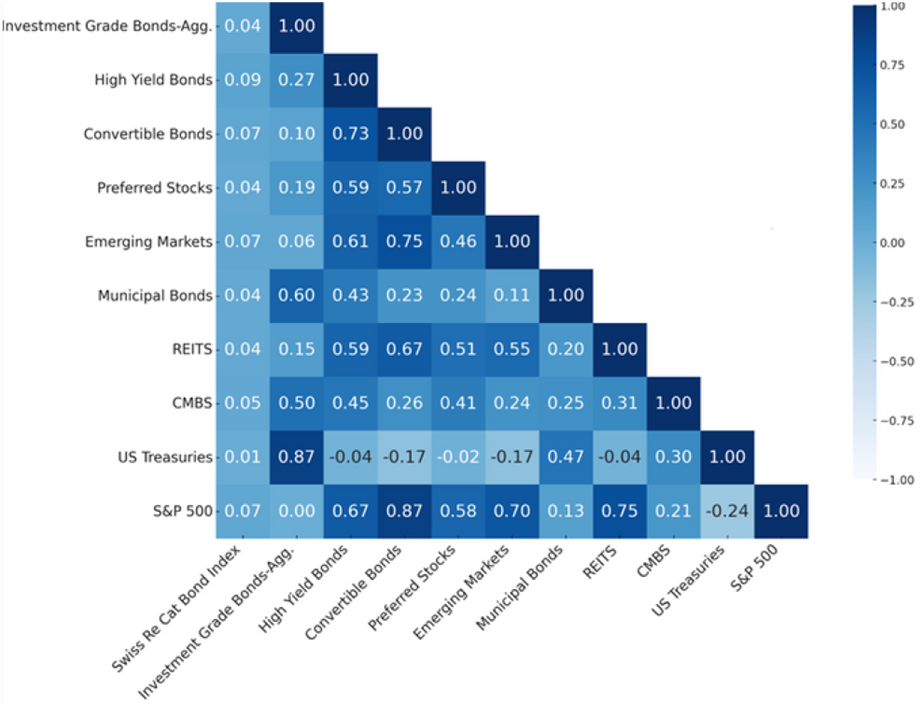


Swiss Re Cat Bond Index


THE EXPANSION OF PRIVATE CREDIT


Private credit's rapid growth over the past fifteen years has been shaped by a combination of regulatory, structural, and market forces.


Following the global financial crisis, new banking regulations significantly altered the economics of lending for many large financial institutions. Capital requirements increased, and banks became less inclined to hold certain types of loans on their balance sheets. In response, non-bank lenders stepped in to fill the gap.


At the same time, investors around the world were searching for income. With government bond yields suppressed for much of the post-crisis period, private credit strategies offered a compelling alternative. Direct lending funds, specialty finance vehicles, and asset-backed lending platforms all experienced substantial inflows.


Today, the private credit market encompasses a wide range of strategies, from middle-market corporate lending to infrastructure finance and asset-backed transactions. Many of these strategies have performed well and have become important components of institutional portfolios.


Yet despite their structural differences, these strategies share a common foundation. They are, at their core, forms of lending. Their performance ultimately depends on borrower cash flows, refinancing conditions, and broader economic stability.


This observation extends to BDCs as well. While BDCs provide access through public markets, they primarily hold portfolios of similar corporate loans, often to middle-market or leveraged borrowers. The wrapper is different, and the trading experience is different, but the core exposure is still tied to the creditworthiness of businesses and the resilience of cash flows.


That distinction matters because investors sometimes treat BDCs as a separate bucket within an income allocation simply because they trade like stocks. In reality, they often function less like a new source of diversification and more like a publicly listed gateway into the same broad credit ecosystem.


This does not diminish the value of private credit or BDCs within a diversified portfolio. Rather, it highlights the importance of understanding where the underlying risks reside and being precise about what is truly diversified versus what is simply packaged differently.


THE CREDIT CYCLE REMAINS CENTRAL


Even though private credit operates outside of public bond markets, it remains closely connected to the broader credit cycle.


Borrowers depend on revenue growth, operating stability, and access to capital markets to service their obligations. When economic conditions are favorable, these dynamics tend to support healthy credit performance. Defaults remain low, and lenders receive consistent income streams.


Periods of stress, however, can affect multiple segments of credit markets simultaneously. Slowing growth, tighter liquidity conditions, or rising borrowing costs can place pressure on leveraged companies and reduce refinancing flexibility.
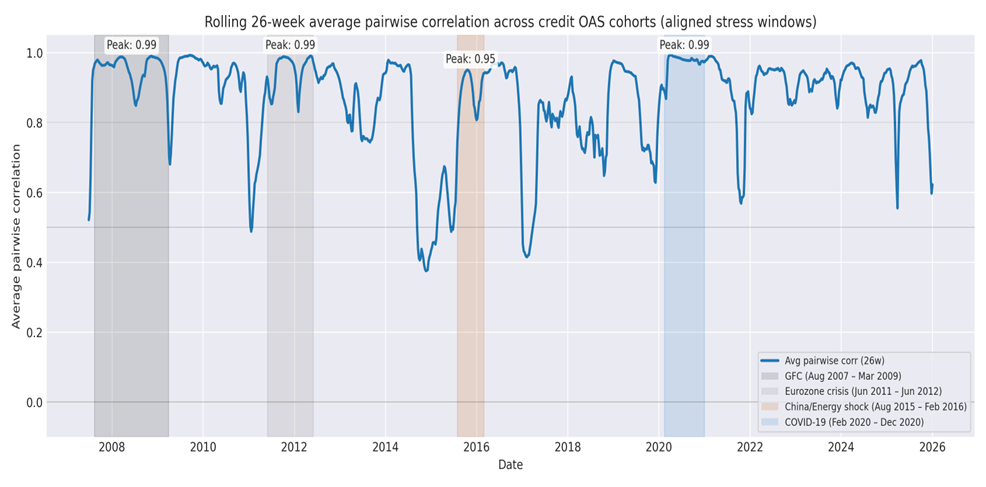
 

Rolling 26-week average pairwise correlation across credit OAS cohorts (aligned stress window)

These dynamics are not unique to private credit. They are inherent to all forms of lending, including BDCs, which may also experience market-driven volatility due to their publicly traded structure. That means BDC investors can face a double layer of discomfort in weak markets: pressure on underlying borrowers and price volatility created by public-market sentiment.


As a result, portfolios that contain numerous credit-based strategies may sometimes be more concentrated than they appear at first glance. A portfolio holding corporate bonds, leveraged loans, private lending funds, structured credit vehicles, and BDCs may look diversified on the surface, yet much of the underlying exposure is still tied to the same economic driver: the creditworthiness of borrowers.


This observation is not intended as a criticism of private credit or BDCs. Many managers maintain disciplined underwriting standards and focus on resilient sectors of the economy. Rather, it reflects a simple reality of portfolio construction: diversification is often strongest when income streams are derived from fundamentally different sources of risk.


INCOME WITHOUT CREDIT EXPOSURE


Insurance-linked securities offer one such alternative.

Catastrophe bonds are designed to transfer specific insurance risks from insurers and reinsurers to investors in capital markets. When an insurer issues a catastrophe bond, it is essentially seeking protection against the financial impact of a predefined natural event. Investors who purchase the bond receive regular coupon payments for assuming that risk.

If the defined catastrophe event does not occur during the life of the bond, investors receive their principal back at maturity along with the coupon payments they have earned. If a qualifying event does occur, some or all of the bond's principal may be used to cover insured losses.


The key point for investors is that the performance of these securities is not driven by corporate earnings, interest coverage ratios, or refinancing markets. The outcomes depend instead on the occurrence and severity of natural catastrophe events.


Because of this structural distinction, catastrophe bonds have historically exhibited low correlation with many traditional financial assets, including both equities and credit strategies. For allocators that already have meaningful exposure to private credit or BDCs, that low correlation is often the most important part of the story, not because cat bonds replace credit, but because they can stand beside it without leaning on the same set of assumptions.


From a portfolio construction standpoint, this independence is significant. It means catastrophe bonds can provide income streams that behave differently from those generated by traditional lending markets, particularly during periods when investors discover that several supposedly separate credit sleeves are all responding to the same macro pressures.


WHEN INTEREST RATES RISE


One of the most interesting differences between catastrophe bonds and many forms of credit becomes visible during periods of rising interest rates.


Private credit and BDC strategies are often structured with floating-rate coupons, which means investors may receive higher income as benchmark rates increase. This feature is frequently highlighted as a strength of the asset class, and in many respects it is.


However, higher rates can have a second-order effect within credit markets. As borrowing costs increase, the companies relying on that credit must allocate a greater portion of their cash flow toward servicing debt. For highly leveraged borrowers, this can gradually erode financial flexibility. In BDC structures, those same concerns may also show up through changes in share prices or discounts to net asset value as public investors reassess the risk.

In other words, rising interest rates can increase both income and pressure within credit portfolios at the same time.


Catastrophe bonds operate under a different dynamic. Like many private credit instruments, catastrophe bonds typically pay floating-rate coupons that include a short-term benchmark rate such as SOFR plus an insurance risk spread. As benchmark rates increase, the coupon received by investors generally increases as well.


The difference lies in what drives the underlying risk. The probability of hurricanes making landfall in the Atlantic or earthquakes occurring along major fault lines does not change because central banks raise interest rates. Natural catastrophe risk is largely independent of monetary policy and economic cycles.


As a result, rising rates can increase the income generated by catastrophe bonds without altering the underlying risk driver in the same way they might for leveraged borrowers. For income-focused investors, this characteristic is relatively unusual. Few income-generating asset classes offer the potential for higher coupons without introducing additional credit stress.


COMPARING SOURCES OF YIELD


From a yield perspective, private credit, BDCs, and catastrophe bonds may appear surprisingly similar.


Private credit and catastrophe bonds have historically offered income levels above those available in traditional investment-grade fixed income. BDCs, meanwhile, are often purchased specifically because they package high levels of distributable income into a public-market format that feels easier to access and monitor.


Yet the economic foundations behind those yields differ. Private credit investors are compensated primarily for assuming lending risk—the possibility that borrowers may face financial difficulty or default. BDC investors are taking on a related set of risks, while also

accepting the additional reality of public-market repricing. Catastrophe bond investors, by contrast, are compensated for assuming a portion of insured catastrophe risk. Their returns depend on the absence of predefined natural events rather than on borrower solvency.


For investors building income portfolios, these distinctions can be valuable. Allocations that combine different types of risk premiums may prove more resilient than those relying heavily on a single source of return. That point often resonates most clearly when markets become less forgiving, and investors realize that the diversity of labels in a portfolio does not always equal diversity of outcomes.


A COMPLEMENTARY ALLOCATION


The continued growth of private credit reflects an important shift in global capital markets. Non-bank lenders now play a critical role in financing businesses and infrastructure, and private credit strategies are likely to remain an important component of institutional portfolios.


BDCs have also become an important access point, especially for investors who prefer the convenience and liquidity of public securities. They broaden access, but they do not change the nature of the underlying exposure. Public or private, the return stream is still grounded in lending risk.


At the same time, investors are increasingly aware that many income strategies ultimately share similar underlying risks. Insurance-linked securities provide an opportunity to broaden the sources of income within a portfolio. By introducing exposure to insurance risk rather than additional credit risk, catastrophe bonds can complement existing lending strategies and potentially enhance overall diversification.


For investors who already maintain substantial credit exposure, even modest allocations to insurance-linked securities may help balance portfolio risks. They are not a substitute for private credit or BDCs, nor do they need to be framed that way. In many cases, the more compelling argument is simply that income portfolios become sturdier when not every source of yield depends on the same corporate and macroeconomic conditions.

In an environment where global debt levels remain elevated and economic cycles continue to evolve, the ability to access income streams that are structurally independent of credit markets may become increasingly valuable.


Important Information and Disclaimer


This document has been prepared by King Ridge Capital Advisors, LLC (“KRCA”) for informational and educational purposes only. The information contained herein is intended solely for professional, institutional, or qualified investors and is not intended for retail investors or the general public.


This document does not constitute an offer to sell, a solicitation of an offer to buy, or a recommendation regarding any security, investment product, or investment strategy. Any such offer or solicitation may only be made pursuant to the relevant offering documents, which should be carefully reviewed before making any investment decision.


The information contained herein should not be construed as investment, legal, tax, accounting, or other professional advice. Recipients should consult their own advisers regarding the appropriateness of any investment strategy discussed in this document. The views expressed herein represent the opinions of KRCA as of the date of publication and are subject to change without notice. Certain statements may constitute forward-looking statements, which involve known and unknown risks and uncertainties that may cause actual results to differ materially from those expressed or implied.


The observations and analysis contained herein, including those related to correlations, diversification, and asset class behavior, are based on historical data and KRCA’s interpretation of market conditions. Such relationships may not persist and can change over time. There can be no assurance that any patterns or trends described herein will continue in future market environments.


Past performance is not indicative of future results. No representation is made that any investment strategy described herein will achieve its objectives or that losses will be avoided.


Comparisons between asset classes, including references to private credit, Business Development Companies (“BDCs”), and insurance-linked securities such as catastrophe bonds (“Cat Bonds”), are provided for illustrative and comparative purposes only. These comparisons are not intended to suggest that any investment strategy is more or less suitable for any particular investor. Statements regarding diversification or concentration are general in nature and may not apply to all portfolios, strategies, or market conditions.

Investments in insurance-linked securities, including catastrophe bonds (“Cat Bonds”), involve risk, including the potential loss of principal. Cat Bond performance is dependent upon the occurrence and severity of insured catastrophe events. Investors may lose some or all of their investment if a qualifying event occurs. Cat Bonds may also be subject to liquidity risk, model risk, and event risk.


Private credit investments involve risks, including credit risk, borrower default risk, liquidity risk, and market risk. References to private credit within this document are provided for illustrative and comparative purposes only.


Investments in BDCs and BDC-focused ETFs involve risks, including credit risk, leverage risk, market price volatility, liquidity risk, and the possibility that shares may trade at discounts or premiums to net asset value. Public market pricing may cause BDC investments to experience greater short-term volatility than the underlying private loans themselves.


Certain information contained herein has been obtained from third-party sources believed to be reliable; however, KRCA makes no representation as to the accuracy or completeness of such information. Index data, including references to the Swiss Re Global Cat Bond Index, are provided for illustrative purposes only and are not directly investable. Index performance does not reflect fees or expenses.


This document may not be reproduced, distributed, or transmitted in whole or in part without the prior written consent of KRCA.


United States. In the United States, this material is intended solely for institutional investors, investment professionals, or other persons who qualify as accredited investors or qualified purchasers under applicable U.S. securities laws. King Ridge Capital Advisors, LLC is an investment adviser registered with the U.S. Securities and Exchange Commission. Registration with the SEC does not imply a certain level of skill or training.


European Economic Area and the United Kingdom. In the European Economic Area and the United Kingdom, this document is intended solely for professional clients and eligible counterparties as defined under MiFID II and applicable regulations. It is not intended for retail clients. Distribution of this document may be restricted in certain jurisdictions, and recipients should inform themselves about and observe any such restrictions.


 

blogHeaderImage
April 07, 2026

Different Labels, Same Credit Risk:

Blog Summary

Quick overview of the article

Private Credit and BDCs May Reinforce Rather Than Diversify Credit Exposure


Over the past decade, private credit has evolved from a relatively specialized strategy into a central allocation within many institutional portfolios. Pension funds, endowments, insurers, and family offices have increasingly embraced the asset class as a way to generate income in an environment where traditional fixed income often struggled to provide attractive yields.


Over the past decade, private credit has evolved from a relatively specialized strategy into a central allocation within many institutional portfolios. Pension funds, endowments, insurers, and family offices have increasingly embraced the asset class as a way to generate income in an environment where traditional fixed income often struggled to provide attractive yields.


The appeal is understandable. Private credit strategies can offer floating-rate income, negotiated lending structures, and access to borrowers outside the public markets. For many investors, these characteristics have provided an appealing combination of yield and portfolio stability, particularly during the extended period of low interest rates that followed the global financial crisis.


At the same time, many investors have accessed similar exposures through publicly traded vehicles such as Business Development Companies, or BDCs, and BDC-focused ETFs. Those vehicles are often approached differently in practice because they offer daily liquidity, ticker-based access, and a familiar public-market wrapper. Even so, the economic engine underneath them remains remarkably similar to what sits inside many private credit portfolios.


As allocations to private credit and BDCs have grown, however, a broader conversation has begun to emerge around diversification within income portfolios. Many portfolios today contain multiple forms of credit exposure, public corporate bonds, leveraged loans, structured credit, private lending strategies, and BDCs, all of which ultimately rely on the same underlying driver: the health of borrowers and the functioning of credit markets.

For this reason, some investors are beginning to explore ways to complement credit-based income with return streams that are not dependent on corporate balance sheets or economic growth. One area that has gradually attracted attention in this context is the market for insurance-linked securities, particularly catastrophe bonds.


Catastrophe bonds, often referred to simply as 'Cat Bonds,' allow insurers to transfer portions of natural catastrophe risk to capital markets. In exchange for assuming that risk, investors receive periodic coupon payments that typically consist of a floating reference rate combined with a risk spread.


Although catastrophe bonds share certain characteristics with traditional fixed income, most notably their income profile, the risks that drive their performance are fundamentally different. Rather than being tied to the financial health of borrowers, catastrophe bond returns are linked to the occurrence of specific insured natural events such as hurricanes or earthquakes.


For investors evaluating the composition of their income portfolios, this distinction can be meaningful. The question is not whether private credit or BDCs remain useful. In many cases, they clearly do. The more practical question is whether adding another form of credit exposure truly improves diversification, or whether it simply adds one more expression of the same risk.


Swiss Re Cat Bond Index


THE EXPANSION OF PRIVATE CREDIT


Private credit's rapid growth over the past fifteen years has been shaped by a combination of regulatory, structural, and market forces.


Following the global financial crisis, new banking regulations significantly altered the economics of lending for many large financial institutions. Capital requirements increased, and banks became less inclined to hold certain types of loans on their balance sheets. In response, non-bank lenders stepped in to fill the gap.


At the same time, investors around the world were searching for income. With government bond yields suppressed for much of the post-crisis period, private credit strategies offered a compelling alternative. Direct lending funds, specialty finance vehicles, and asset-backed lending platforms all experienced substantial inflows.


Today, the private credit market encompasses a wide range of strategies, from middle-market corporate lending to infrastructure finance and asset-backed transactions. Many of these strategies have performed well and have become important components of institutional portfolios.


Yet despite their structural differences, these strategies share a common foundation. They are, at their core, forms of lending. Their performance ultimately depends on borrower cash flows, refinancing conditions, and broader economic stability.


This observation extends to BDCs as well. While BDCs provide access through public markets, they primarily hold portfolios of similar corporate loans, often to middle-market or leveraged borrowers. The wrapper is different, and the trading experience is different, but the core exposure is still tied to the creditworthiness of businesses and the resilience of cash flows.


That distinction matters because investors sometimes treat BDCs as a separate bucket within an income allocation simply because they trade like stocks. In reality, they often function less like a new source of diversification and more like a publicly listed gateway into the same broad credit ecosystem.


This does not diminish the value of private credit or BDCs within a diversified portfolio. Rather, it highlights the importance of understanding where the underlying risks reside and being precise about what is truly diversified versus what is simply packaged differently.


THE CREDIT CYCLE REMAINS CENTRAL


Even though private credit operates outside of public bond markets, it remains closely connected to the broader credit cycle.


Borrowers depend on revenue growth, operating stability, and access to capital markets to service their obligations. When economic conditions are favorable, these dynamics tend to support healthy credit performance. Defaults remain low, and lenders receive consistent income streams.


Periods of stress, however, can affect multiple segments of credit markets simultaneously. Slowing growth, tighter liquidity conditions, or rising borrowing costs can place pressure on leveraged companies and reduce refinancing flexibility.


Rolling 26-week average pairwise correlation across credit OAS cohorts (aligned stress window)

These dynamics are not unique to private credit. They are inherent to all forms of lending, including BDCs, which may also experience market-driven volatility due to their publicly traded structure. That means BDC investors can face a double layer of discomfort in weak markets: pressure on underlying borrowers and price volatility created by public-market sentiment.


As a result, portfolios that contain numerous credit-based strategies may sometimes be more concentrated than they appear at first glance. A portfolio holding corporate bonds, leveraged loans, private lending funds, structured credit vehicles, and BDCs may look diversified on the surface, yet much of the underlying exposure is still tied to the same economic driver: the creditworthiness of borrowers.


This observation is not intended as a criticism of private credit or BDCs. Many managers maintain disciplined underwriting standards and focus on resilient sectors of the economy. Rather, it reflects a simple reality of portfolio construction: diversification is often strongest when income streams are derived from fundamentally different sources of risk.


INCOME WITHOUT CREDIT EXPOSURE


Insurance-linked securities offer one such alternative.

Catastrophe bonds are designed to transfer specific insurance risks from insurers and reinsurers to investors in capital markets. When an insurer issues a catastrophe bond, it is essentially seeking protection against the financial impact of a predefined natural event. Investors who purchase the bond receive regular coupon payments for assuming that risk.

If the defined catastrophe event does not occur during the life of the bond, investors receive their principal back at maturity along with the coupon payments they have earned. If a qualifying event does occur, some or all of the bond's principal may be used to cover insured losses.


The key point for investors is that the performance of these securities is not driven by corporate earnings, interest coverage ratios, or refinancing markets. The outcomes depend instead on the occurrence and severity of natural catastrophe events.


Because of this structural distinction, catastrophe bonds have historically exhibited low correlation with many traditional financial assets, including both equities and credit strategies. For allocators that already have meaningful exposure to private credit or BDCs, that low correlation is often the most important part of the story, not because cat bonds replace credit, but because they can stand beside it without leaning on the same set of assumptions.


From a portfolio construction standpoint, this independence is significant. It means catastrophe bonds can provide income streams that behave differently from those generated by traditional lending markets, particularly during periods when investors discover that several supposedly separate credit sleeves are all responding to the same macro pressures.


WHEN INTEREST RATES RISE


One of the most interesting differences between catastrophe bonds and many forms of credit becomes visible during periods of rising interest rates.


Private credit and BDC strategies are often structured with floating-rate coupons, which means investors may receive higher income as benchmark rates increase. This feature is frequently highlighted as a strength of the asset class, and in many respects it is.


However, higher rates can have a second-order effect within credit markets. As borrowing costs increase, the companies relying on that credit must allocate a greater portion of their cash flow toward servicing debt. For highly leveraged borrowers, this can gradually erode financial flexibility. In BDC structures, those same concerns may also show up through changes in share prices or discounts to net asset value as public investors reassess the risk.

In other words, rising interest rates can increase both income and pressure within credit portfolios at the same time.


Catastrophe bonds operate under a different dynamic. Like many private credit instruments, catastrophe bonds typically pay floating-rate coupons that include a short-term benchmark rate such as SOFR plus an insurance risk spread. As benchmark rates increase, the coupon received by investors generally increases as well.


The difference lies in what drives the underlying risk. The probability of hurricanes making landfall in the Atlantic or earthquakes occurring along major fault lines does not change because central banks raise interest rates. Natural catastrophe risk is largely independent of monetary policy and economic cycles.


As a result, rising rates can increase the income generated by catastrophe bonds without altering the underlying risk driver in the same way they might for leveraged borrowers. For income-focused investors, this characteristic is relatively unusual. Few income-generating asset classes offer the potential for higher coupons without introducing additional credit stress.


COMPARING SOURCES OF YIELD


From a yield perspective, private credit, BDCs, and catastrophe bonds may appear surprisingly similar.


Private credit and catastrophe bonds have historically offered income levels above those available in traditional investment-grade fixed income. BDCs, meanwhile, are often purchased specifically because they package high levels of distributable income into a public-market format that feels easier to access and monitor.


Yet the economic foundations behind those yields differ. Private credit investors are compensated primarily for assuming lending risk—the possibility that borrowers may face financial difficulty or default. BDC investors are taking on a related set of risks, while also

accepting the additional reality of public-market repricing. Catastrophe bond investors, by contrast, are compensated for assuming a portion of insured catastrophe risk. Their returns depend on the absence of predefined natural events rather than on borrower solvency.


For investors building income portfolios, these distinctions can be valuable. Allocations that combine different types of risk premiums may prove more resilient than those relying heavily on a single source of return. That point often resonates most clearly when markets become less forgiving, and investors realize that the diversity of labels in a portfolio does not always equal diversity of outcomes.


A COMPLEMENTARY ALLOCATION


The continued growth of private credit reflects an important shift in global capital markets. Non-bank lenders now play a critical role in financing businesses and infrastructure, and private credit strategies are likely to remain an important component of institutional portfolios.


BDCs have also become an important access point, especially for investors who prefer the convenience and liquidity of public securities. They broaden access, but they do not change the nature of the underlying exposure. Public or private, the return stream is still grounded in lending risk.


At the same time, investors are increasingly aware that many income strategies ultimately share similar underlying risks. Insurance-linked securities provide an opportunity to broaden the sources of income within a portfolio. By introducing exposure to insurance risk rather than additional credit risk, catastrophe bonds can complement existing lending strategies and potentially enhance overall diversification.


For investors who already maintain substantial credit exposure, even modest allocations to insurance-linked securities may help balance portfolio risks. They are not a substitute for private credit or BDCs, nor do they need to be framed that way. In many cases, the more compelling argument is simply that income portfolios become sturdier when not every source of yield depends on the same corporate and macroeconomic conditions.

In an environment where global debt levels remain elevated and economic cycles continue to evolve, the ability to access income streams that are structurally independent of credit markets may become increasingly valuable.


Important Information and Disclaimer


This document has been prepared by King Ridge Capital Advisors, LLC (“KRCA”) for informational and educational purposes only. The information contained herein is intended solely for professional, institutional, or qualified investors and is not intended for retail investors or the general public.


This document does not constitute an offer to sell, a solicitation of an offer to buy, or a recommendation regarding any security, investment product, or investment strategy. Any such offer or solicitation may only be made pursuant to the relevant offering documents, which should be carefully reviewed before making any investment decision.


The information contained herein should not be construed as investment, legal, tax, accounting, or other professional advice. Recipients should consult their own advisers regarding the appropriateness of any investment strategy discussed in this document. The views expressed herein represent the opinions of KRCA as of the date of publication and are subject to change without notice. Certain statements may constitute forward-looking statements, which involve known and unknown risks and uncertainties that may cause actual results to differ materially from those expressed or implied.


The observations and analysis contained herein, including those related to correlations, diversification, and asset class behavior, are based on historical data and KRCA’s interpretation of market conditions. Such relationships may not persist and can change over time. There can be no assurance that any patterns or trends described herein will continue in future market environments.


Past performance is not indicative of future results. No representation is made that any investment strategy described herein will achieve its objectives or that losses will be avoided.


Comparisons between asset classes, including references to private credit, Business Development Companies (“BDCs”), and insurance-linked securities such as catastrophe bonds (“Cat Bonds”), are provided for illustrative and comparative purposes only. These comparisons are not intended to suggest that any investment strategy is more or less suitable for any particular investor. Statements regarding diversification or concentration are general in nature and may not apply to all portfolios, strategies, or market conditions.

Investments in insurance-linked securities, including catastrophe bonds (“Cat Bonds”), involve risk, including the potential loss of principal. Cat Bond performance is dependent upon the occurrence and severity of insured catastrophe events. Investors may lose some or all of their investment if a qualifying event occurs. Cat Bonds may also be subject to liquidity risk, model risk, and event risk.


Private credit investments involve risks, including credit risk, borrower default risk, liquidity risk, and market risk. References to private credit within this document are provided for illustrative and comparative purposes only.


Investments in BDCs and BDC-focused ETFs involve risks, including credit risk, leverage risk, market price volatility, liquidity risk, and the possibility that shares may trade at discounts or premiums to net asset value. Public market pricing may cause BDC investments to experience greater short-term volatility than the underlying private loans themselves.


Certain information contained herein has been obtained from third-party sources believed to be reliable; however, KRCA makes no representation as to the accuracy or completeness of such information. Index data, including references to the Swiss Re Global Cat Bond Index, are provided for illustrative purposes only and are not directly investable. Index performance does not reflect fees or expenses.


This document may not be reproduced, distributed, or transmitted in whole or in part without the prior written consent of KRCA.


United States. In the United States, this material is intended solely for institutional investors, investment professionals, or other persons who qualify as accredited investors or qualified purchasers under applicable U.S. securities laws. King Ridge Capital Advisors, LLC is an investment adviser registered with the U.S. Securities and Exchange Commission. Registration with the SEC does not imply a certain level of skill or training.


European Economic Area and the United Kingdom. In the European Economic Area and the United Kingdom, this document is intended solely for professional clients and eligible counterparties as defined under MiFID II and applicable regulations. It is not intended for retail clients. Distribution of this document may be restricted in certain jurisdictions, and recipients should inform themselves about and observe any such restrictions.


Neil Hause
Author

Neil Hause

Neil Hause is a Partner and Executive at King Ridge Capital Advisors with more than 40 years of experience in financial services. His work focuses on insurance-linked securities (ILS) and casualty risk investment strategies for institutional investors, RIAs, broker-dealers, pensions, endowments, and family offices.

Share this article

Help others discover this content.

Recent Posts

© 2026 King Ridge Capital Inc.. All Rights Reserved.