Forced Selling, Uncertainty, and Drawdown Behavior
Why Catastrophe Bond ETFs Reprice Without Deleveraging
Periods of market stress are often accompanied by a wave of selling driven not by fundamentals, but by balance-sheet constraints, funding pressures, and forced deleveraging. As a result, there is a natural presumption that catastrophe bonds — particularly in ETF form — will behave like high-yield credit during periods of macro stress, experiencing indiscriminate selling and liquidity breakdowns. This paper argues that such a presumption is analytically and structurally misplaced when evaluated through the mechanics of catastrophe bond markets.
For Professional and Institutional Investors Only. Not Investment Advice.
Not Investment Advice. This material contains forward-looking statements; actual results may differ materially. Capital is at risk and past performance is not indicative of future results. Please refer to the Important Disclosures at the end of this document.
Abstract
Periods of market stress are often accompanied by a wave of selling driven not by fundamentals, but by balance-sheet constraints, funding pressures, and forced deleveraging. As a result, there is a natural presumption that catastrophe bonds — particularly in ETF form — will behave like high-yield credit during periods of macro stress, experiencing indiscriminate selling and liquidity breakdowns. This paper argues that such a presumption is analytically and structurally misplaced when evaluated through the mechanics of catastrophe bond markets.
Catastrophe bonds (cat bonds) are frequently described as uncorrelated, floating rate instruments whose performance is driven primarily by natural disasters. However, evidence from catastrophe bond index behavior during recent stress episodes—most notably the 2017 and 2022 hurricane seasons—shows that drawdowns and liquidity dynamics differ in qualitatively important and structural ways from those observed in leveraged credit markets. In 2017, Hurricanes Harvey, Irma, and Maria generated the largest cat bond losses in history, yet the Swiss Re Global Cat Bond Index finished the year approximately flat. In contrast, Hurricane Ian in 2022 produced smaller ultimate losses but was accompanied by a negative index return of roughly 2.3 percent.[1] The divergence was driven not by loss magnitude, but by the breadth and duration of uncertainty.
Using comparative drawdown analysis, event time recovery paths, return decomposition, and bid ask microstructure evidence from the catastrophe bond market, this paper shows that cat bond drawdowns are characterized by uncertainty driven mark to market repricing rather than balance sheet driven forced selling. Temporary price declines have typically reversed as information has resolved and coupon carry has accrued, in contrast to high yield credit markets where leverage, funding constraints, and investor redemptions amplify stress and delay recovery.
While catastrophe bond ETFs have not yet experienced a full stress cycle since their recent introduction, observed behavior in the underlying catastrophe bond market provides a structural framework for assessing plausible ETF dynamics. Historically, stress in cat bonds has remained orderly when three features are present: no leverage, diversification that localizes event uncertainty, and transparency that lets market participants separate affected from unaffected risk. These features stand in sharp contrast to the structural drivers of deleveraging in high yield credit markets and help explain why catastrophe bonds have historically exhibited lower sensitivity to macro driven forced selling dynamics than many leveraged credit markets.
1. Forced Selling as a Market Mechanism
Forced selling arises when price moves impair an investor’s capacity to hold assets rather than merely their willingness to do so. In modern financial markets, this most often occurs when uncertainty meets balance sheet constraints—such as leverage that amplifies mark-to-market volatility, margin calls or financing haircuts triggered by price declines, withdrawal of short-term funding, and vehicles with redemption-linked liquidity obligations. These dynamics can produce mechanically driven liquidation and drawdowns that are disproportionate to realized losses.
These mechanisms are endemic to leveraged fixed-income markets, particularly high-yield credit. The remainder of this paper examines catastrophe bonds as a structural counterexample: an asset class that can experience uncertainty and repricing, but does not rely on the same financing, margining, or redemption channels that typically transmit stress into deleveraging driven drawdowns.
2. Drawdowns and the Role of Forced Selling
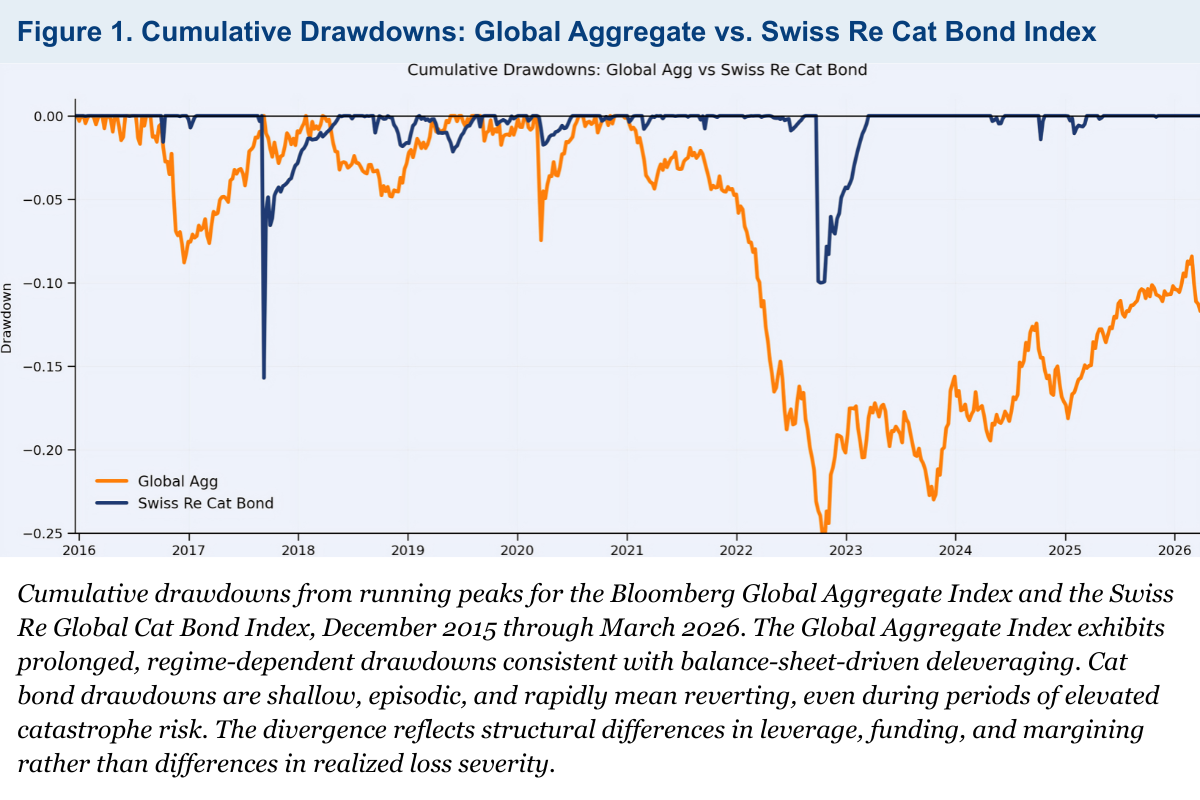
This distinction is most clearly observed in drawdown behavior. Prolonged drawdowns in traditional fixed-income indices (for example, the Bloomberg Global Aggregate Index) are not primarily driven by realized defaults or credit losses. Instead, they often reflect balance sheet driven stress transmitted through limits on dealer capacity, duration extension and convexity effects, risk constraints (including VAR), and redemption driven selling.
By contrast, the Swiss Re Global Cat Bond Index has historically exhibited a different drawdown profile. Over comparable multi-year periods, drawdowns have tended to be episodic, relatively shallow, and mean reverting. Even during elevated catastrophe uncertainty—such as major hurricane seasons—declines have not typically compounded or persisted in the way often observed in leveraged credit markets.
Figure 1 illustrates the contrast. The divergence in drawdown behavior is consistent with forced selling as a dominant mechanism in many fixed-income stress episodes: where balance sheet constraints are present, drawdowns can deepen and persist; where they are absent, stress is more likely to be expressed through repricing rather than deleveraging.
3. Structural Anatomy of Catastrophe Bond ETFs
Catastrophe bond ETFs invest exclusively in publicly issued catastrophe bonds and explicitly exclude private reinsurance arrangements such as sidecars and quota shares. This distinction is foundational. Public catastrophe bonds are fully collateralized, unlevered instruments with standardized documentation, defined triggers, observable secondary pricing, and continuous coupon accrual. They are not financed via repo, margin, or other short-term funding arrangements.
At the fund level, catastrophe bond ETFs operate without leverage, margining, or financing linked to market prices. Creations and redemptions may be processed in cash, but the ability to redeem in kind provides an important additional tool: the fund can meet outflows by delivering a pro rata basket of bonds rather than selling bonds into the secondary market during periods of elevated spreads. This can help limit stress driven transaction costs and helps keep event uncertainty from turning into mechanically forced selling. Volatility is therefore expressed primarily through price adjustment rather than balance sheet driven distress.
Private reinsurance contracts, by contrast, are typically annual and indemnity based, with extended settlement timelines that can materially prolong uncertainty and trap capital. Mixing these exposures into a portfolio introduces liquidity risk that is distinct from and unrelated to the functioning of the publicly traded catastrophe bond market.
4. Uncertainty Versus Deleveraging: 2017 and 2022
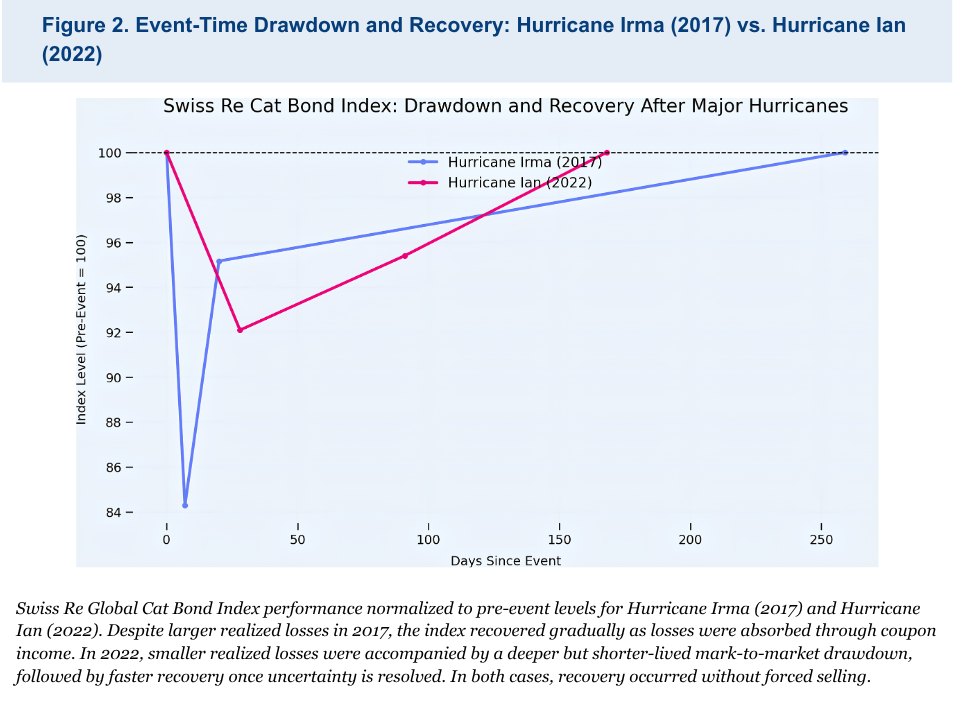
The distinction between repricing and deleveraging is most clearly illustrated by the differing outcomes of the 2017 and 2022 hurricane seasons. Consistent with the drawdown behavior shown in Figure 1, periods of elevated catastrophe uncertainty produced drawdowns in catastrophe bonds that subsequently reversed as information resolved, in contrast to the more persistent drawdowns observed in leveraged fixed income markets.
In 2017, Hurricanes Harvey, Irma, and Maria generated approximately $2.5 billion of catastrophe bond principal loss—the largest in history—yet the Swiss Re Global Cat Bond Index finished the year approximately flat. Loss triggers were clearly breached, the universe of “bonds in doubt” was limited, and uncertainty resolved relatively quickly. Coupon carry largely offset realized losses, and mark-to-market impact was modest.
In 2022, Hurricane Ian produced materially smaller ultimate catastrophe bond losses (approximately $1.75 billion), yet the index declined by roughly 2.3 percent. The divergence was driven not by loss magnitude, but by the breadth and duration of uncertainty. Near attachment exposures across multiple bonds, protracted loss development, and delayed resolution generated broader mark-to-market discounting that temporarily outweighed income.
Importantly, in neither case did uncertainty evolve into mechanical deleveraging. The drawdown path was governed primarily by the pace of information resolution rather than by binding balance sheet constraints.
5. Return Decomposition, Diversification, and Liquidity Dynamics Under Stress
A decomposition of catastrophe bond returns helps clarify the drivers of stress period performance. Coupon carry has historically remained resilient during stress episodes, reflecting the contractual income nature of the asset class, while realized losses have tended to be discrete and bounded. Short-term performance variability has therefore been dominated by mark-to-market movements associated with unresolved loss expectations rather than by realized capital impairment.
Crucially, uncertainty has been transmitted into prices—yet contained within portfolios—through diversification across peril, geography, and attachment point. Well constructed catastrophe bond portfolios localize event uncertainty to the subset of potentially affected bonds rather than allowing it to propagate across the entire portfolio.
Equally important is transparency for investors and market intermediaries, particularly authorized participants and secondary market makers. Public catastrophe bonds feature standardized documentation, defined triggers, observable attachment points, and funded collateral, allowing market participants to assess exposure with precision even when ultimate losses remain uncertain. This transparency reduces adverse selection risk (i.e., the risk of trading disproportionately with better informed sellers), supporting more continuous price discovery and helping authorized participants evaluate and hedge creation/redemption baskets during stress.
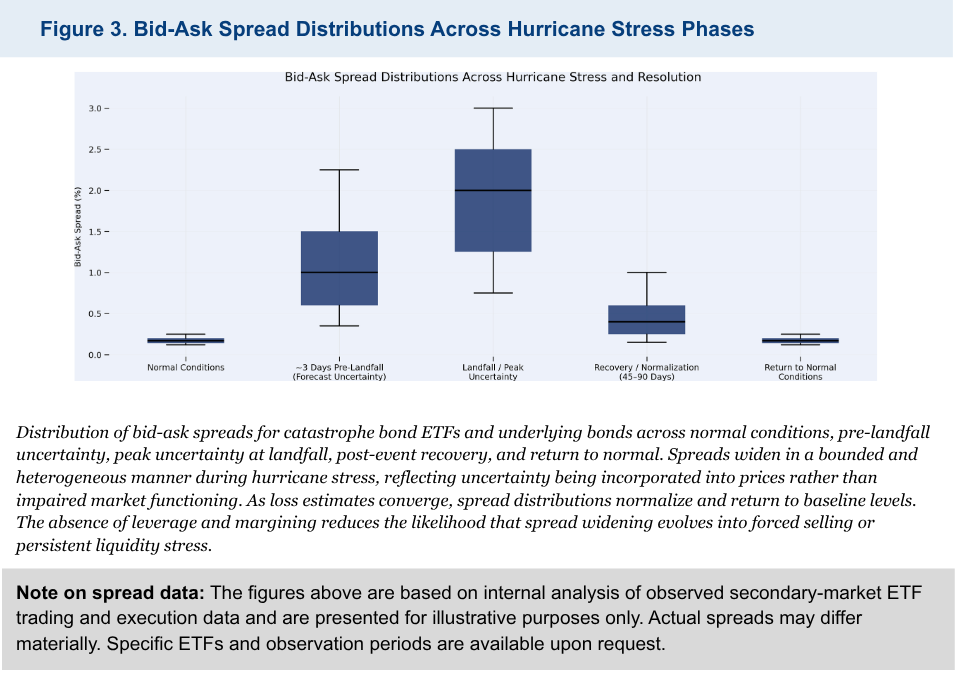
Bid ask spreads provide a direct lens into how uncertainty, diversification, and transparency show up in market microstructure. Under normal conditions, catastrophe bond ETFs have traded with relatively tight average bid ask spreads, while the underlying catastrophe bond market has historically exhibited wider but orderly spreads. During periods of elevated uncertainty surrounding major hurricanes, spreads have widened in a bounded and selective manner: directly exposed bonds trade wider, while bonds outside the affected region or attachment layer remain closer to baseline.
Figure 3 summarizes these regimes. The widening is asymmetric and heterogeneous, reflecting uncertainty being incorporated into prices rather than a broad breakdown in market functioning. As loss estimates stabilize and information resolves, spread distributions have tightened and liquidity conditions have tended to normalize.
6. Liquidity: Market Functioning Versus Portfolio Design
Isolated gating events observed in 2017 did not necessarily indicate systemic dysfunction in the publicly issued catastrophe bond market. Secondary market liquidity in public catastrophe bonds generally remained functional; the gating instead reflected fund level liquidity terms and portfolio construction—most notably exposure to private reinsurance contracts with long dated, indemnity based settlement timelines.
This distinction highlights the difference between market liquidity and fund level liquidity. Pure play catastrophe bond ETFs that invest exclusively in publicly issued catastrophe bonds may reduce exposure to trapped capital and extended uncertainty associated with private reinsurance. Emphasizing transparency, diversification, and tradability can help mitigate liquidity risk that arises from asset–liability mismatches during stress events.
7. Comparative Stress Behavior: Cat Bonds Versus High-Yield Credit
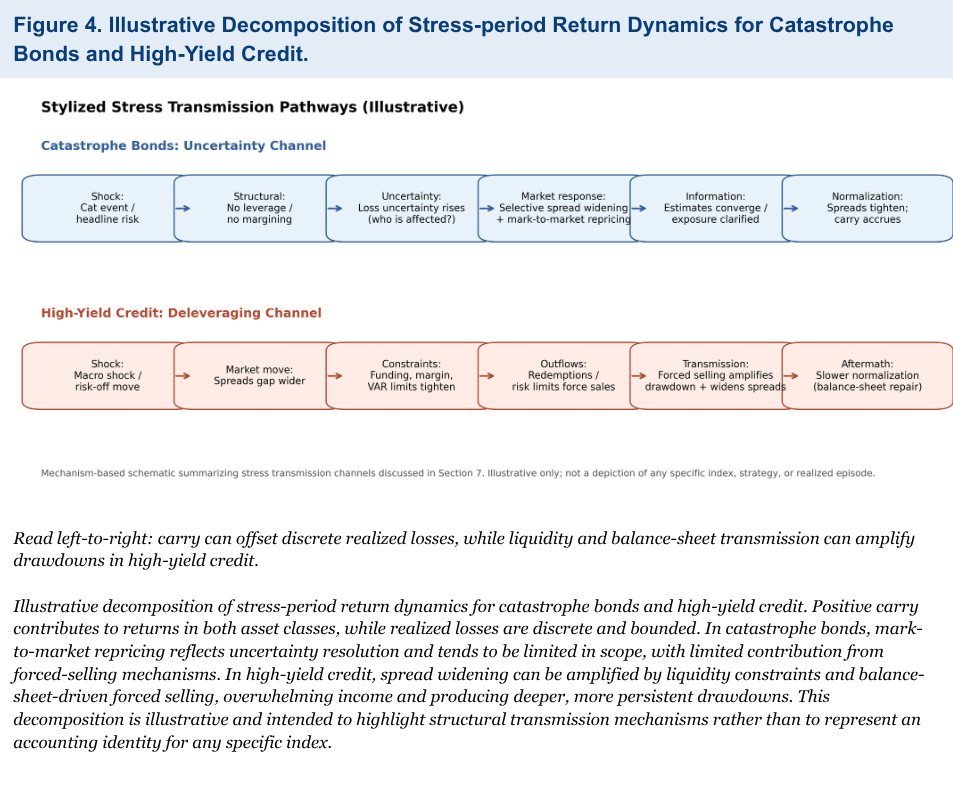
The contrasting stress behavior of catastrophe bonds and high-yield credit is best understood through a structural lens. The discussion in this section is mechanism based and illustrative: it highlights how income, realized losses, and liquidity transmission interact under stress rather than presenting an accounting identity for any single index or episode. The key distinction is between uncertainty driven repricing and balance sheet driven forced selling—two dynamics that can produce superficially similar price moves but materially different drawdown and recovery paths.
In catastrophe bonds, coupon income continues to accrue while stress is expressed primarily through mark-to-market repricing as loss expectations evolve and then resolve. Observed microstructure in the underlying market suggests that bid ask spreads can widen in a bounded and selective manner during periods of event uncertainty and tighten as information improves. High- yield credit, by contrast, is more exposed to balance sheet constraints and redemption linked liquidity demands that can amplify spread widening into deleveraging regimes. The difference in stress behavior is therefore predominantly structural, reflecting the presence and transmission of forced selling mechanisms rather than differences in underlying risk severity.
8. Conclusion: Repricing Without Deleveraging
Catastrophe bond ETFs are often misinterpreted through analogies drawn from leveraged credit markets. While hurricanes introduce uncertainty and volatility, they do not typically activate the structural mechanisms responsible for forced selling. The analysis in this paper indicates that catastrophe bonds have tended to reprice under stress without entering deleveraging regimes. Drawdowns have tended to be shallow, bounded, and mean reverting, consistent with the absence of binding balance sheet constraints in the asset class.
One implication for portfolio construction follows from this distinction. Catastrophe bonds are not crisis immune, and they may be less exposed than many leveraged credit instruments to deleveraging driven selling dynamics. In an environment where forced selling increasingly shapes market outcomes, this structural difference can be more consequential than correlation alone. Taken together, the evidence in this paper indicates that resilience to deleveraging in catastrophe bond ETFs is conditioned on three reinforcing structural features: no leverage, diversification that localizes event uncertainty, and transparency that lets market participants separate affected from unaffected risk. Properly constructed pure play catastrophe bond ETFs may provide a differentiated combination of income, diversification, and structural resilience—penalizing uncertainty temporarily while rewarding patience through information resolution.
Important Disclosures
For professional and institutional investors only. This document is intended solely for qualified institutional buyers (as defined under Rule 144A of the U.S. Securities Act of 1933) and sophisticated investors under applicable law. It is not intended for retail investors and may not be redistributed without the prior written consent of King Ridge Capital Advisors. For distribution in the EU/EEA, this document is intended solely for professional clients as defined under MiFID II (Directive 2014/65/EU, Article 4(1)(10)).
Not investment advice. This material is provided for informational and educational purposes only and does not constitute investment advice, a solicitation, or a recommendation to buy, sell, or hold any security or financial instrument. Any views expressed are those of the author(s), based on available information, and are subject to change without notice.
Regulatory status. King Ridge Capital Advisors is an investment adviser registered with the U.S. Securities and Exchange Commission. Registration does not imply a certain level of skill or training. Information regarding advisory services and fees is available in Form ADV at www.adviserinfo.sec.gov.
Conflicts of interest. King Ridge Capital Advisors and/or its affiliates may manage, advise, or hold positions in catastrophe bond ETFs or the underlying catastrophe bond market. The firm may receive compensation, directly or indirectly, in connection with the marketing or distribution of such products. Accordingly, this material may not be independent of the firm’s commercial interests. Data referenced may rely on third party indices (including the Swiss Re Global Cat Bond Total Return Index), and no independent verification of underlying methodologies has been performed.
Index disclosure. One cannot invest directly in the Swiss Re Catastrophe Bond Total Return Index. The index is unmanaged and is not available for direct investment. Index returns do not include the impact of fees or expenses Index returns do not include the impact of fees or expenses associated with this investment product.
Forward-looking statements and analysis framework. This document may contain forward looking statements based on assumptions and interpretations of market structure and historical data. Actual outcomes may differ materially. The analysis presented is based on observed catastrophe bond index behavior, market microstructure, and structural interpretation of risk transmission. Portions of the analysis—particularly those relating to catastrophe bond ETF behavior under stress—are inferential and illustrative and do not represent actual ETF performance through a full stress cycle.
ETF structural limitations. Catastrophe bond ETFs have a limited operating history and have not experienced all potential market environments. Discussions of ETF behavior under stress are based on the characteristics of the underlying asset class and observed market behavior and should not be interpreted as guarantees of future ETF performance or investor experience.
Costs and charges. Investment in catastrophe bond ETFs involves fees and expenses, including management fees, operating expenses, and transaction costs. These reduce returns and are not reflected in index performance data. Investors should review relevant offering documents for a full description of costs.
Market and liquidity risks. Investments in catastrophe bonds involve risks, including but not limited to:
• loss of principal
• event driven losses tied to natural catastrophes
• liquidity risk and potential bid ask spread widening
• valuation uncertainty during periods of stress
• ETF specific risks, including deviations between market price and net asset value
In stressed conditions, ETF shares may trade at premiums or discounts to NAV, and market participants—including authorized participants—may reduce or suspend activity, affecting liquidity and execution.
Data and methodology. Supporting data and calculation methodologies underlying figures, spread ranges, and return decompositions are based on a combination of internal analysis and third party data sources and are available upon request. Results may vary depending on methodology, assumptions, and selected time periods.
Past performance. Past performance is not indicative of future results.
PRIIPs / KID (EU/EEA). This document does not replace a Key Information Document (KID) as required under PRIIPs Regulation (EU) 1286/2014. EU/EEA investors should review the applicable KID prior to making an investment decision.
Recordkeeping. This document reflects information available as of April 2026 unless otherwise noted and should be reviewed periodically for continued accuracy. King Ridge Capital Advisors may update this material but does not guarantee distribution of revised versions.
NOTES
[1] Swiss Re Global Cat Bond Index (SRCATTRR). Index levels: 1/1/2017 = 320.41; 12/31/2017 = 321.88 (+0.458%). 1/1/2022 = 383.12; 12/31/2022 = 374.58 (−2.254%). Past results are not necessarily indicative of future results.
[2] Catastrophe bond ETFs are a recently introduced vehicle. ETF-specific liquidity and spread behavior under stress is inferred from the underlying cat bond market, not observed directly in ETF form. Investors should review the applicable prospectus and offering documents before investing.
[3] Bloomberg Global Aggregate Index. Bloomberg L.P., index methodology and historical performance data.
[4] Swiss Re Institute, sigma No. 1/2018. Natural catastrophes and man-made disasters in 2017.
[5] Swiss Re Institute, sigma No. 1/2023. Natural catastrophes and man-made disasters in 2022.
[6] Internal analysis based on observed secondary-market ETF trading and execution data. Average bid-ask spread across the full trading history is approximately 28.5 bps; over the most recent 75 trading days at the time of this article, approximately 13 bps. Figures are illustrative; specific ETFs and periods are available upon request.
[7] Swiss Re weekly catastrophe bond pricing sheets circulated to market participants.
Principal Risk Factors
The following risk factors do not purport to be a complete description of all risks associated with an investment in catastrophe bond ETFs. Prospective investors should carefully review the applicable prospectus, Statement of Additional Information, KID, and any other offering documents before making any investment decision.
Catastrophe event risk and principal loss
Catastrophe bonds are subject to loss of principal if a defined trigger event occurs. Principal losses are discreet and can be substantial, up to 100 percent of the face amount of an affected bond. The occurrence of a catastrophe cannot be predicted.
Basis risk and trigger risk
Many catastrophe bonds use parametric or industry-loss triggers rather than indemnity triggers. This introduces basis risk — the risk that a covered event causes substantial losses to the issuer but does not trigger the bond, or that a bond is triggered by an event that causes limited actual losses.
Liquidity risk
Although the secondary market for publicly issued cat bonds has generally remained functional during past stress episodes, liquidity can deteriorate meaningfully during periods of elevated uncertainty. Bid-ask spreads may widen substantially. At the ETF level, the ability to create and redeem shares depends in part on the willingness and capacity of authorized participants, which may be reduced during stress periods. Gate provisions have been imposed in certain cat bond fund structures in the past; investors should review the specific liquidity terms and gating rights applicable to any product.
Loss development and extension risk
Following a triggering catastrophe event, loss estimation and settlement can be protracted, sometimes extending over multiple years for indemnity-based triggers. During this period, affected bonds may trade at significant discounts to par, materially affecting short-term performance even where ultimate losses prove modest relative to initial estimates.
Geographic and peril concentration risk
Catastrophe bond portfolios are inherently concentrated in specific perils (predominantly U.S. hurricane, U.S. earthquake, and European windstorm) and geographies. A single large event in a concentrated exposure zone can simultaneously affect multiple bonds in a portfolio.
Currency risk
Most catastrophe bonds are denominated in U.S. dollars. Non-USD investors are subject to currency exchange rate fluctuations that may increase or decrease the value of their investment independent of underlying bond performance.
ETF-specific risks
Catastrophe bond ETFs are subject to risks specific to the ETF structure, including tracking error, authorized participant risk (if authorized participants are unwilling or unable to engage in creation/redemption activity, the ETF may trade at a significant premium or discount to NAV), and market price risk. ETF premium/discount risk: shares of the ETF may trade at prices materially above or below NAV, particularly during periods of market stress or reduced authorized participant activity, and there is no assurance that the arbitrage mechanism will always function efficiently. Authorized participant concentration risk: the number of institutions willing to act as authorized participants for catastrophe bond ETFs is limited; if one or more authorized participants withdraw from the market, liquidity in both the primary and secondary markets for ETF shares may be materially impaired. Investors should not assume that the ETF will continuously trade near NAV.
Limited track record
Catastrophe bond ETFs have not yet experienced a full market stress cycle in ETF form. Conclusions about expected ETF behavior under stress are inferred from the underlying market, not from direct ETF observation. Actual ETF behavior under stress may differ materially from these inferences.