The Diversification Case for Cat Bonds: 20 Years of Low-Correlation Returns
A $65 billion market, three consecutive years of double-digit returns, and a correlation to stocks and bonds close to zero — catastrophe bonds may be a potentially useful diversification tool most allocators have never used.
Executive Summary
Most portfolios are built from the same underlying ingredients: claims on corporate profits, claims on government or corporate debt, and, increasingly, claims on real assets. Whatever the label on the fund, those returns tend to move together when it matters most — in a recession, a rate shock, or a liquidity crunch. Catastrophe bonds are one of a small number of instruments whose return is driven by something else entirely: whether a hurricane makes landfall, whether the ground shakes, whether a wildfire crosses a containment line. It is a distinct, event-driven risk premium — and that difference is precisely why it may be among the most underused tools in the portfolio-construction toolkit today.
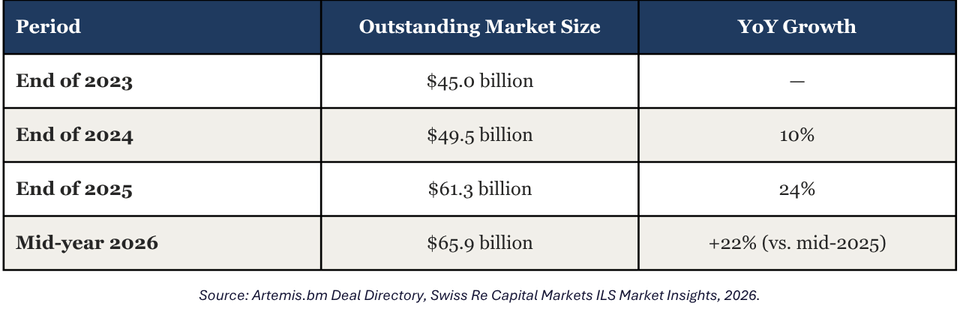
The catastrophe bond market has more than doubled in size since 2020, reaching an outstanding notional of roughly $65.9 billion by mid-2026, and has delivered three consecutive years of double-digit total returns even as equities and bonds moved in tandem through episodes of macro stress. Over the same period, the index has also produced a stronger risk-adjusted return profile than most other fixed income and credit-sensitive asset classes, examined in detail later in this paper. Correlations, returns, spreads, and market liquidity can change materially over time, particularly after major catastrophe events or during periods of broader market stress, so this historical pattern is not a guarantee of future behavior. Yet allocations from U.S. retail investors, and from many institutional portfolios, remain minimal relative to the diversification benefit these historical figures suggest. This white paper examines why: what catastrophe bonds are, how they behave, what the data shows about their role in a portfolio, and what an investor should weigh before allocating.
1. A Market Coming Into Its Own
Catastrophe (“cat”) bonds emerged in the mid-1990s after Hurricane Andrew and the Northridge earthquake exposed how concentrated insurers had let catastrophe risk become, and how thin the traditional reinsurance market was relative to the exposure it was being asked to absorb. Insurers and reinsurers needed a way to move some of that risk off their own balance sheets and into the far larger pool of global capital markets. Cat bonds were the answer: a security that allows a sponsor to transfer a defined slice of catastrophe risk to investors in exchange for a coupon, funded by capital markets rather than reinsurance capacity alone.
For most of the following two decades, the market grew steadily but remained a niche corner of institutional fixed income, dominated by specialist hedge funds and a handful of pension plans. That has changed decisively. Issuance has broken records in four of the last five years.
The catastrophe bond market shattered a host of records in 2025 — and many expect another banner year as investors flock to what has been an often-overlooked asset class.
— CNBC, citing Artemis.bm data, February 2026
Full-year issuance reached a record $25.6 billion in 2025, up 45% on the prior record set in 2024. That momentum has continued into 2026: the first half of the year set new records for both total issuance and deal count, with the outstanding market climbing to roughly $65.9 billion by mid-year — up from about $49.5 billion at the end of 2024. Industry forecasts from Swiss Re Capital Markets and other market participants generally point to continued growth through the remainder of the decade as more sponsors, including sovereign and municipal issuers, turn to the capital markets for catastrophe protection.
Figure 1 — Outstanding Cat Bond Market Growth
2. How Catastrophe Bonds Work
A catastrophe bond is, mechanically, a floating-rate note issued by a special-purpose insurance vehicle. An insurer, reinsurer, government, or corporation (the “sponsor”) pays a risk premium into the vehicle in exchange for coverage against a defined catastrophe — a hurricane above a certain intensity, an earthquake above a certain magnitude, or aggregate industry losses above a certain threshold. Investors buy the notes issued by that vehicle, and their principal is held in a fully collateralized trust account, typically invested in short-term U.S. Treasuries or similar instruments.
Investors are paid a coupon that combines two components: the return on the collateral (effectively a money-market or T-bill rate) and the insurance risk premium the sponsor pays for protection. If no qualifying catastrophe occurs during the bond's term — typically one to five years, with three to four years most common — investors receive their coupons and get their principal back at maturity. If a qualifying event does occur, some or all of the principal is used to pay the sponsor's claim, and investor losses can range from partial to total.
Three trigger mechanisms are most common in the market today: indemnity triggers, which pay out based on the sponsor's actual incurred losses; industry-loss triggers, which pay out based on modeled losses to the insurance industry as a whole; and parametric triggers, which pay out automatically once an event's physical parameters (wind speed, earthquake magnitude, rainfall) cross a pre-agreed threshold, regardless of actual loss. Parametric structures have found growing use in sovereign and development-finance contexts — Jamaica's World Bank-backed cat bond, for example, paid out in full within weeks after Hurricane Melissa met its parametric thresholds in late 2025, providing the government with immediate liquidity for disaster response rather than the months or years a traditional claims process might require.
3. The Diversification Case
The core argument for catastrophe bonds is not a yield argument — it is a correlation argument. Whether a hurricane forms in the Atlantic has no relationship to interest rate policy, corporate earnings, or credit spreads. That structural independence from the financial and economic cycle is borne out in the long-term data summarized below.
Over the 20 years through September 30, 2025, the Swiss Re Cat Bond Index produced an average annual return of 7.88% with standard deviation of just 5.64% — a combination that compares favorably on a risk-adjusted basis to most other fixed income and credit-sensitive asset classes over the same period.
Figure 2 — 20-Year Risk/Return Comparison Across Fixed Income & Credit Asset Classes
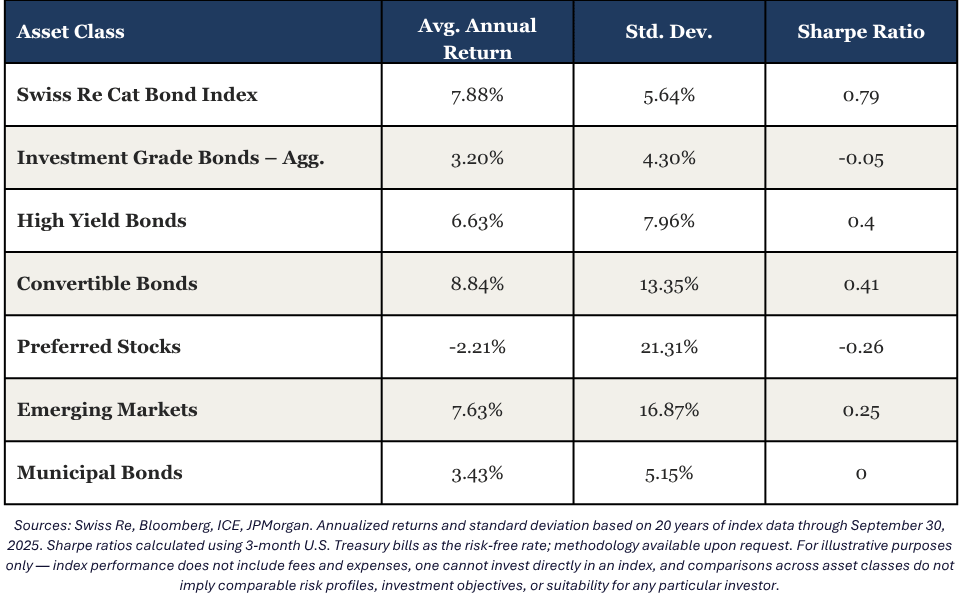
This favorable risk-adjusted profile holds because cat bond returns are driven by insured catastrophe events rather than by the same macroeconomic forces that move traditional fixed income and equity markets. Correlation to investment-grade bonds sits at just 0.04 and to municipal bonds at 0.04, while the more equity- and credit-sensitive instruments in the table — high yield, convertibles, preferred stock, and emerging market debt — are all highly correlated with one another, frequently above 0.6, because their returns share a common exposure to credit and equity-market risk.
Catastrophe bonds sit outside that cluster entirely, and the pattern holds against a much broader set of mainstream benchmarks as well. These correlation figures reflect the historical periods analyzed and are not guaranteed to persist; correlations, including those of catastrophe bonds to other asset classes, may rise during periods of acute market stress or in the aftermath of major catastrophe events.
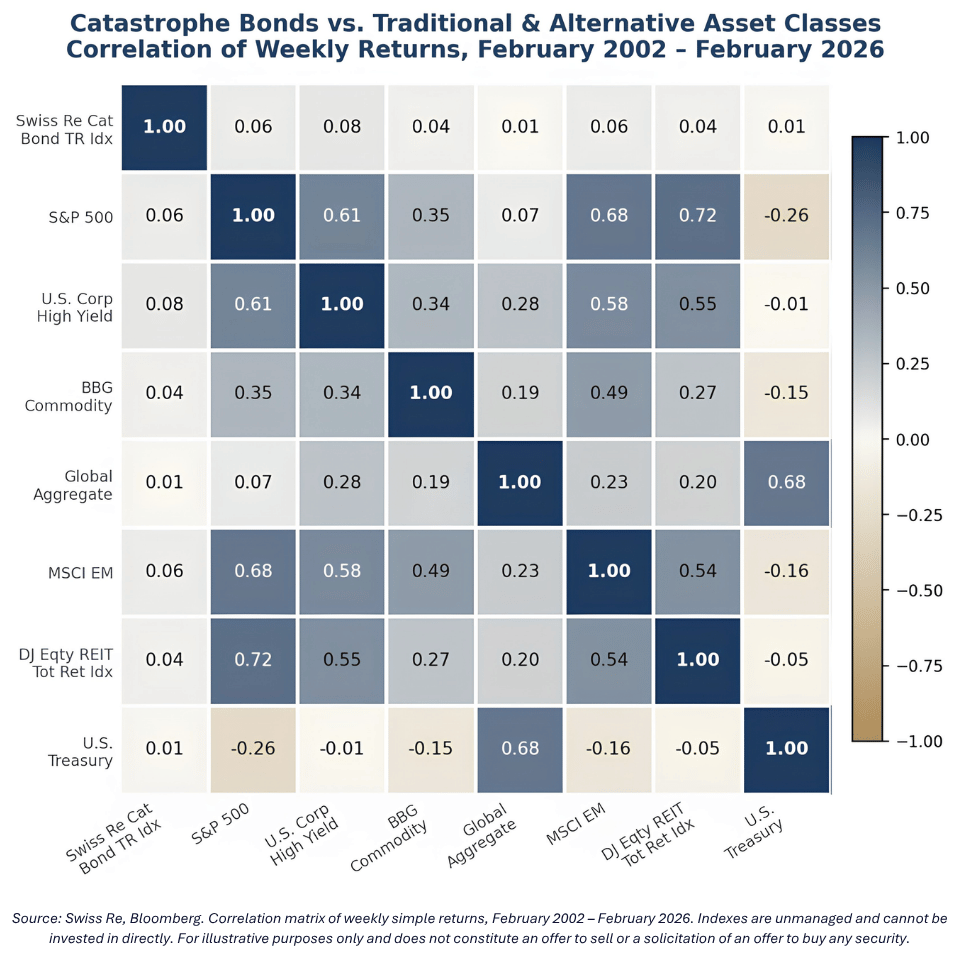
The Swiss Re Cat Bond Index's highest correlation to any other asset class shown over the period examined — equities, high yield, commodities, global bonds, emerging markets, REITs, or Treasuries — is just 0.08. Every other pairing in the matrix regularly runs several multiples higher. Returns linked to insured events, not financial markets, is the throughline: it is the reason this asset class behaves differently from everything else already sitting in a typical portfolio, not just somewhat differently.
Taken together, this analysis points to several practical implications for portfolio construction:
- Low correlation with traditional asset classes: Catastrophe bonds exhibit minimal correlation with both equities and fixed income, making them effective diversifiers that can reduce overall portfolio volatility.
- Resilience to macroeconomic shocks: Because cat bond returns are primarily driven by insurance events rather than economic cycles, they can offer a source of stability during periods of broader market stress or recession.
- Different source of tail risk: Catastrophe bonds may help diversify equity-, credit-, and rate-driven drawdowns, but they introduce their own event-driven catastrophe risk, including the potential for partial or total principal loss on affected bonds — a trade-off explored further in Section 5.
4. A NOTABLE PERFORMANCE TRACK RECORD
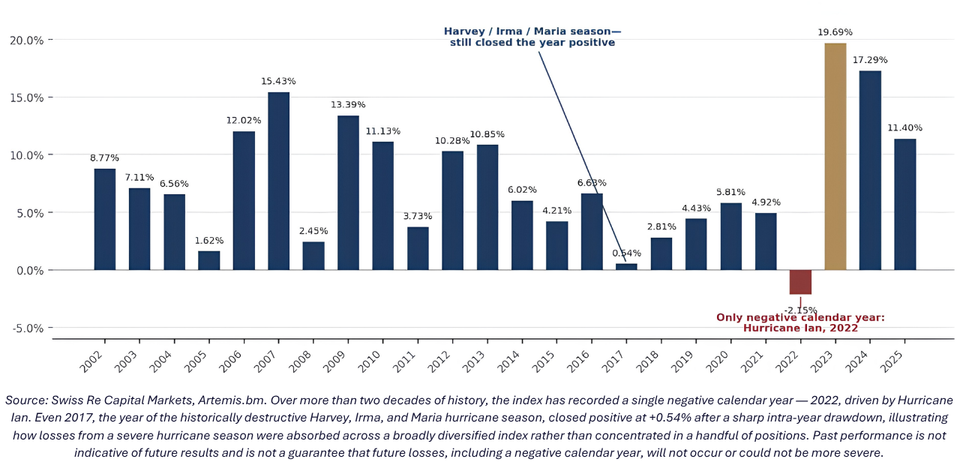
Diversification is more compelling when it does not require sacrificing return, and cat bonds have not required much sacrifice recently. The Swiss Re Global Cat Bond Performance Index delivered three consecutive years of double-digit total returns: an index-record-setting year of 19.69% in 2023, 17.29% in 2024 (the second-highest calendar-year return in the index's history), and 11.40% in 2025 — the sixth-best year on record despite active loss events, including the January 2025 California wildfires and an aggregate-loss-driven dip in April. This recent performance reflects market conditions during the stated period and should not be viewed as representative of future returns.
The moderation in 2025 returns relative to 2023–2024 reflects lower collateral yields as short-term rates eased, and tighter risk spreads as capital continued to flow into the asset class — not a deterioration in the underlying risk transfer economics. Since 2021, the index has delivered a cumulative total return of roughly 61%, with Hurricane Ian in 2022 standing as the only calendar year of negative performance over the index's full history — shown in full in Figure 6, in the following section.
5. RISK CONSIDERATIONS
Perhaps the most common hesitation investors voice about catastrophe bonds is also the most direct one: the concern that a single hurricane or earthquake could result in the loss of some or all of an investment. That concern is fair, and it accurately describes what can happen to any one individual bond if its specific trigger is met. It describes something different, however, once that bond sits inside a properly constructed portfolio rather than standing alone. whole. In a well-diversified portfolio, a single hurricane or earthquake is designed to affect a modest slice of total assets, not the entirety of an investment.
Catastrophe bonds also behave differently from credit instruments in a way that is easy to overlook: their losses are generally less directly linked to corporate-credit contagion because triggers are tied to specified physical events rather than borrower solvency. Credit market selloffs are often self-reinforcing — falling prices can trigger margin calls and forced deleveraging, which drive further selling and spread stress across otherwise unrelated issuers and sectors. A loss on a Florida hurricane bond has no causal relationship to a loss on a California earthquake bond or a Japanese typhoon bond; each is triggered by a distinct, physically independent event, and the asset class's general absence of leverage means there is typically no margin-call or forced-selling dynamic of the kind that can accelerate losses in leveraged credit strategies. However, the catastrophe bond market can still experience broader price pressure after major events, during periods of uncertainty, or when secondary-market liquidity deteriorates — diversification reduces concentration risk, it does not remove risk altogether, and this remains a meaningfully different, but not risk-free, loss profile than the one most fixed income investors are used to thinking about.
Figure 6 — Swiss Re Global Cat Bond Index, Calendar-Year Total Returns (2002–2025)
Like any specialist asset class, catastrophe bonds carry risks that deserve a plain, direct explanation rather than a footnote. Three are the most relevant:
• Event and tail risk: A single severe event can generate a sharp, immediate loss on an affected bond, with losses running as high as 100% of principal in the worst case; upside is capped by the coupon, while downside tracks actual catastrophe severity.
• Model and basis risk: Non-indemnity triggers pay out based on a model or index rather than realized losses, which can create a mismatch with actual experience; evolving climate assumptions can also shift pricing and expected losses over a bond's term.
• Liquidity and concentration: The secondary market can be thin in stressed conditions, and U.S. wind and earthquake risk still dominate issuance — so diversification across peril and geography has to be built deliberately, not assumed.
Rating agencies have echoed similar caution as the market has grown — KBRA, for one, notes that sponsors with thinner capital buffers may face sharper rating pressure after a severe loss event. None of this is a reason to dismiss the category; it's a reason to apply the same diligence used for any specialist fixed income strategy, which is exactly what a professionally managed, diversified vehicle is built to do — the subject of the next section.
6. ACCESSING THE ASSET CLASS
Historically, direct access to catastrophe bonds was effectively limited to institutional investors, specialist hedge funds, and accredited investors able to meet the minimums and diligence requirements of private placements and Rule 144A offerings. That has begun to change. A small number of registered fund structures — open-end mutual funds and, more recently, exchange-traded funds — now offer exposure to diversified pools of catastrophe bonds and related instruments in a daily-liquid, regulated wrapper, extending access to a broader base of financial advisors and their clients.
For investors evaluating any such vehicle, the questions worth asking are the same ones that matter for the asset class generally: how is the portfolio diversified across peril and geography, how are triggers structured, what is the fund's approach to secondary-market liquidity, and how does its underwriting team think about model risk. Those questions — more than the headline yield — are generally the best indicator of how a given fund or manager will behave across a full catastrophe cycle, not just a benign one.
CONCLUSION
Catastrophe bonds ask an investor to underwrite something most of a portfolio doesn't: not the economy, not corporate earnings, not central bank policy, but the physical world itself. That is precisely what makes the asset class behave so differently from everything else already sitting in a typical allocation — and precisely why it remains less familiar to many allocators despite a growing public index history. A market that has more than doubled in size since 2020, delivered three consecutive years of double-digit returns, and produced a risk-adjusted return profile that compares favorably to most other fixed income and credit-sensitive asset classes is not a footnote. It represents a notable historical record within specialist fixed income — built largely out of view of investors who have simply never had a reason to look.
Put the two central charts in this paper side by side, and a clear pattern emerges. Figure 2 shows a 0.79 Sharpe ratio for the Swiss Re Cat Bond Index over the period examined — ahead of every other category in that comparison, including high yield (0.40), convertibles (0.41), emerging market debt (0.25), municipal bonds (0.00), and investment-grade bonds (-0.05). Figure 6 shows exactly one negative calendar year across more than two decades of history since 2002 — a decline of 2.15% in 2022 — smaller than the ordinary swings many conventional bond categories absorb in an unremarkable year, let alone a stressed one. Few, if any, other fixed income categories can point to that combination of return, volatility, and drawdown history over a comparable stretch.
That gap between the record and the allocation most portfolios actually hold is the real story here. Catastrophe bonds carry genuine, structural risks — Section 5 lays them out plainly, including the potential for principal loss on an individual bond — and that risk is exactly why position sizing and manager diligence matter. But a specialist risk profile is a reason to size a catastrophe bond allocation thoughtfully, not a reason to treat it as optional. On this record, catastrophe bonds may merit consideration as part of a diversified fixed income allocation, subject to an investor's objectives, risk tolerance, and overall portfolio construction.
Important Disclosures
This material is provided for informational and educational purposes only and does not constitute investment, legal, or tax advice, or an offer to sell or a solicitation of an offer to buy any security, including shares of any exchange-traded fund. Any such offer or solicitation may only be made by means of an applicable prospectus, which should be read carefully before investing.
Catastrophe bonds and insurance-linked securities involve substantial risk, including the potential loss of principal resulting from specified catastrophic events, and are not suitable for all investors. Diversification does not ensure a profit or protect against loss. Past performance is not indicative of future results.
Index performance shown throughout this document (including the Swiss Re Cat Bond Index, Bloomberg Global Aggregate Index, and other referenced benchmarks) is for illustrative purposes only, is unmanaged, and does not include the deduction of fees, expenses, or transaction costs. One cannot invest directly in an index. Comparisons across asset classes are for general informational purposes only and do not imply comparable risk profiles, investment objectives, or suitability for any particular investor. Correlations may change over time and are not guaranteed.
Opinions expressed reflect the analysis as of the date of publication and are subject to change without notice.
No assurance of low correlation: Correlations shown are historical and may increase during periods of market stress or following major catastrophe events.
Climate and model uncertainty: Catastrophe risk models rely on assumptions that may prove inaccurate, including assumptions related to climate, exposure growth, insured values, building standards, and claims inflation.
Liquidity and valuation: Catastrophe bonds may be less liquid than traditional fixed income instruments, and valuations may rely on broker quotes, third-party pricing services, or models, particularly during stressed markets.
Index and data source limitations: Indexes may differ materially from actual investable portfolios due to eligibility criteria, rebalancing, pricing methodology, transaction costs, fees, taxes, and liquidity constraints.
Forward-looking statements: Certain statements in this document, including those regarding market growth, future issuance, or continued institutional adoption, are forward-looking and reflect current expectations, estimates, and assumptions as of the date of publication. Actual outcomes may differ materially from those expressed or implied, and no assurance can be given that any such expectations will be realized.
No fiduciary relationship: This document does not create a fiduciary, advisory, or agency relationship between the reader and any preparer, distributor, or sponsor of this material, and does not take into account the objectives, financial situation, or needs of any specific investor.
Investors should consult with their own financial, legal, and tax advisers before making any investment decision regarding catastrophe bonds, insurance-linked securities, or any related fund or strategy.
Sources: Artemis.bm, Swiss Re Capital Markets, Bloomberg, ICE Data Services, J.P. Morgan. This document is intended as generic, unbranded educational commentary on the catastrophe bond asset class as a whole. It does not name, describe, or promote any specific investment adviser, broker-dealer, fund, or product, and is not attributed to any such entity. Before this material is used, distributed, or adapted by any specific firm, it should be reviewed and, if necessary, revised by that firm's Compliance function and outside counsel to confirm it meets applicable requirements under the SEC Marketing Rule (Advisers Act Rule 206(4)-1) and, where applicable, FINRA Rule 2210.